
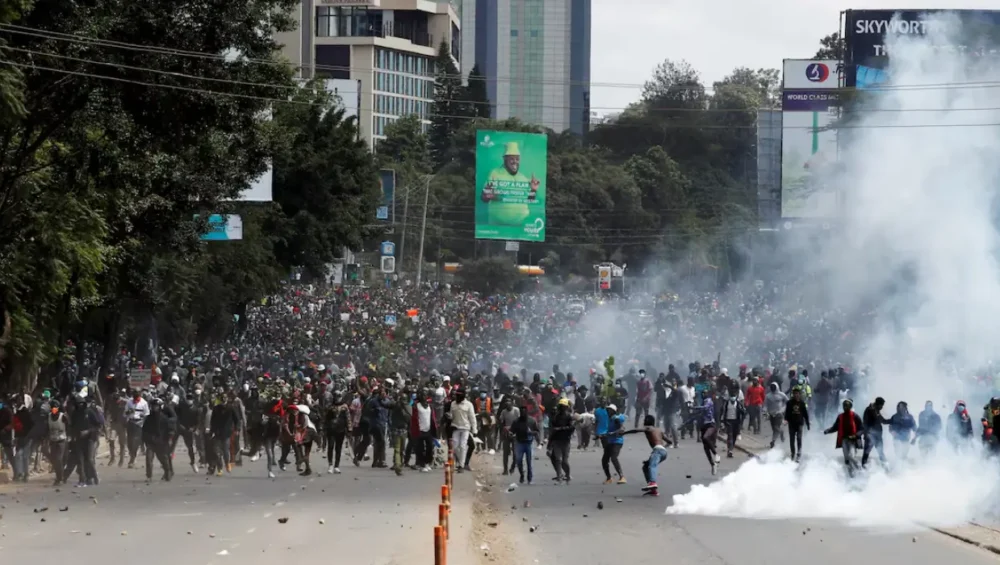
Kenya’s string of you-led protests that have been happening since 2024 has turned out to be one of the biggest tests of President William Ruto’s administration, owing to entrenched inequality in terms of economics, arrested democratization, and mistrust of public institutions. What began as a demonstration against planned taxes has now become a full-blown movement.
The demonstrations, primarily organized through digital media such as TikTok, X, and WhatsApp by Gen Z activists, indicate a generational break with the old Kenyan ruling class and an opposition to the current economy of extraction and debt service pursued at the expense of the welfare of the citizens of the republic.
Historical Roots: The 2024 Finance Bill and Kenya’s Debt Crisis
The immediate cause of the unrest was a disputed 2024 Finance Bill proposing new and increased levies on essential items such as bread, fuel, cooking gas, and sanitary products. The government admitted the measures were necessary to meet IMF revenue targets as Kenya struggled to come to terms with a debt overburden above 70 percent of GDP-the highest in sub-Saharan Africa.
Public debt soared by over 73 percent as of mid-2024 from about 41 percent of GDP in 2013, according to World Bank data, due to heavy infrastructure borrowing, Eurobond repayments, and currency depreciation. This debt consumed over 55 percent of the government’s revenue in the fiscal year 2023-2024, crowding out spending on health, education, and social protection..
Young Kenyans, most of whom work in the informal sector, which employs more than 80 percent of the total employment, demonized the bill for being retrogressive and unfair. With amendments and even after President Ruto’s veto on June 26, 2024, such protests only grew louder rather than dissipating into wider demands for Ruto’s resignation over claims of corruption, elite profligacy, and broken campaign promises, including a costly State House renovation in the middle of austerity.
Economic Inequality and Youth Marginalization
The issue of economic inequality is at the heart of this protest movement. Official unemployment in Kenya is about 13 percent, though unofficial unemployment is put at much higher numbers. The official statistics from the Kenya National Bureau of Statistics show that about one in five youths out of a total of 18-34 years is either not in employment, education, or training.
The high rate of inflation caused by increasing prices of food and fuels continued to reduce further the purchasing power of citizens in 2023 and 2024. Human rights organizations contend that actions taken by the government, at the behest of the IMF, to reduce subsidies and consumption taxes only widened income inequality without curbing graft and mismanagement.
Police Brutality and the Crisis of Accountability
Another area of complaint within the populace is government accountability, particularly after the brutal security crackdown of the 2024 protests. By July 2024, the death toll of the protesting citizens was over 50, with dozens injured. Amnesty international and Human Rights Watch reported live ammunition, tear gas at point-blank range, unmarked law enforcers, and forced disappearance incidents.
However, the situation again escalated in the year 2025, following the death of a blogger, Albert Omondi Ojwang, in the custody of the police, which brought about the resurgence of protests in the country. Demonstrations that took place around Saba Saba Day, which is synonymous with the pro-democracy cause in Kenya, again saw the incidence of violence, resulting in the death toll rising to at least 120 people since June 2024, which included innocent bystanders as well as the likes of a 12-year-old girl, Bridgit Njoki, shot dead in
Yet, in spite of the public’s anger, few have been prosecuted. Even today, according to Amnesty International and other rights groups, there remains widespread impunity, with only a few police officers suspended and none having been arrested.
Timeline of Escalation and State Response
Protests that began in the country from June 18 to the 25th, 2024, in opposition to the Finance Bill reached a crescendo in that protesters invaded the Parliament, a first in the country’s recent history. The protests claimed the lives of at least 22 persons and injured over 200 before the bill was eventually vetoed.
In July 2024, the disturbances were marked by “seven days of rage” protests, leading to the sacking of several cabinets and the resignation of the National Police Commissioner. By mid-2025, after Ojwang’s death, protests resumed leading to the arrest of more than 1,500 protesters, causing the National Assembly to be suspended temporarily.
There were localized protests, such as those by the informal traders like the Kitengela Hawkers, throughout 2026, even as the government formed its own compensation panel amid rising alerts from civil society organizations over the potential election violence leading up to the 2027 elections.
Government Measures and Democratic Backsliding
President Ruto responded with a mix of concessions and repression. He reshuffled his cabinet twice, bringing in opposition figures, dissolved several state corporations under austerity measures, and authorized military support for police operations—moves that sparked constitutional challenges.
Authorities repeatedly labeled protests as “treasonous” or acts of “terrorism.” Security forces employed mass arrests—often indiscriminate—digital surveillance, and coordination with unidentified armed groups. CIVICUS and the Kenya Human Rights Commission reported cases of abductions, secret detention sites, and intimidation of journalists.
Courts intervened intermittently, suspending protest bans and ordering police to wear visible identification, but enforcement has been inconsistent.
Human and Economic Costs
The human toll has been severe: more than 120 deaths, thousands injured, and over 3,000 arrests since 2024. NGOs report widespread trauma, particularly among youth, and growing mistrust of law enforcement.
Economically, protests disrupted businesses, damaged infrastructure, and further strained investor confidence already weakened by debt risks and currency instability. Meanwhile, activists have organized crowdfunding campaigns and legal aid networks to support victims, filling gaps left by state institutions.
These largely leaderless, digitally coordinated protests represent a profound shift in Kenyan politics. Scholars writing in the Journal of Democracy describe the movement as a rejection of elite-driven politics and ethnic mobilization, signaling the emergence of issue-based, youth-centered activism.
Ruto’s legitimacy—once anchored in his 2022 “hustler” narrative—has eroded sharply. As the 2027 elections approach, opposition figures are exploring international legal avenues, including potential referrals to the International Criminal Court, while youth activists push for sweeping anti-corruption and policing reforms.