
Israel has announced it will suspend the operations of dozens of humanitarian organisations in Gaza within 36 hours for allegedly failing to meet stringent requirements to share personal details of Palestinian and international staff. The organizations which will be impacted by these changes include some of the most well-known organizations across the world, such as ActionAid, the International Rescue Committee, and Médecins Sans Frontières, or MSF.
#Gaza : Israël vient d’interdire 37 ONGs qui apportent une aide vitale à la population palestinienne dont @MSF @MdM_France @CARE @Oxfam
— amnestyfrance (@amnestyfrance) December 31, 2025
C’est une stratégie de punition collective, une violation du droit international.
Le monde doit agir. Chaque heure d’inaction coûte des vies.
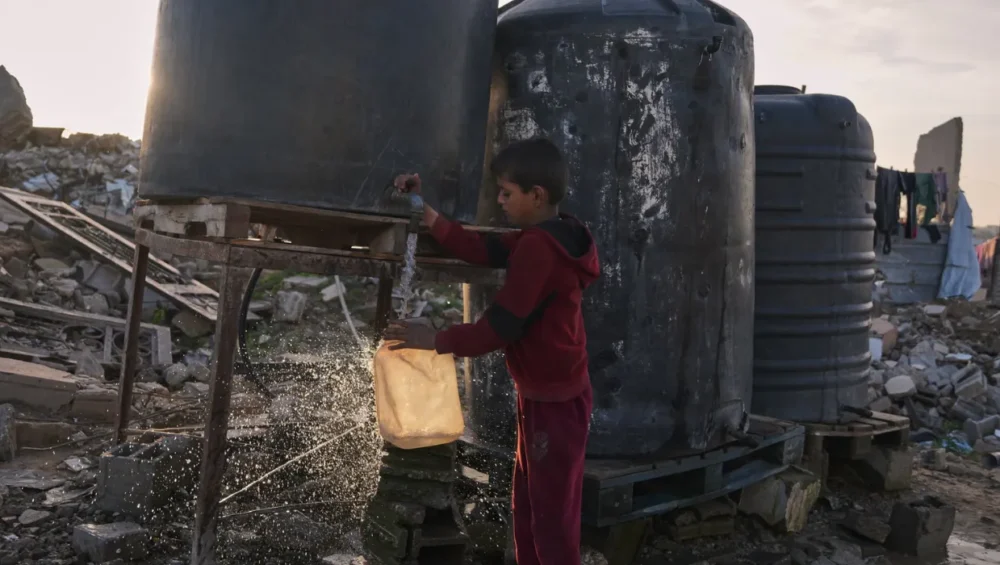
This is especially happening at a time when Gaza is experiencing extreme winter storms, which the homes of thousands of people are living in tents that are destroyed, thereby worsening the prevalent humanitarian crisis. It is expected to leave the affected populations devoid of basic food, shelter, and health services.
Severe storms, strong winds, and rain in #Gaza have damaged and destroyed make-shift tents.
— UNRWA (@UNRWA) December 31, 2025
The Israeli Authorities continue to block UNRWA from directly bringing aid into the Gaza Strip – including enough shelter supplies for hundreds of thousands of people.
Tents and… pic.twitter.com/zkMrGoZJ9s
How many people are at risk due to collapsing infrastructure?
A joint statement signed by the foreign ministers of Britain, Canada, Denmark, Finland, France, Iceland, Japan, Norway, Sweden, and Switzerland termed the situation in Gaza “catastrophic.” In this statement, 1.3 million people were cited as requiring urgent shelter support.
As winter sets in, over 1.3 million people desperately need shelter in Gaza. There remains appalling and preventable levels of hunger too. Despite the ceasefire, the Israeli government is still blocking vital aid – including bedding items, tarpaulin, tents and solar lights. pic.twitter.com/Rip2rpzG6Z
— Oxfam International (@Oxfam) December 22, 2025
The number of health facilities that are operating partially is more than half of the health facilities located in Gaza. This is together with 740,000 people who are at risk of being harmed by the poisonous floodwater. The new limitation on health materials entering Gaza might make the health crisis worse since dozens of essential health materials are banned.
In #Gaza, heavy rainfall has caused flooding across multiple displacement sites, disrupting services and damaging hundreds of tents.
— UNRWA (@UNRWA) December 30, 2025
UNRWA teams are clearing clogged sewage systems, opening drainage channels, and pumping floodwater to mitigate risks and restore basic services.… pic.twitter.com/SwKbNMp8aT
What is the human cost of aid restrictions?
As reported by the World Food Programme, nearly 60% of Gaza’s population is food insecure at the moment, and thousands of children are at risk of serious malnutrition. As stated by UNICEF, over 7,500 children have died because of malnutrition and starvation-related illnesses since the ceasefire of October 2023 due to the delay of humanitarian aid, specifically in Gaza.
More than half a million people in #Gaza are trapped in famine, according to a new IPC analysis.
— World Food Programme (@WFP) August 22, 2025
Famine is confirmed when three critical thresholds – extreme food deprivation, acute malnutrition and starvation-related deaths – have been breached.
An immediate ceasefire is the… pic.twitter.com/gpt88DINtp
Families are also at an increased risk as continuing displacement, very harsh weather conditions, and poverty make children susceptible to illness and exploitation. “A protected child is a secure future,” said a UNICEF field officer, emphasizing the long-term consequences of restricted aid.
Why are NGOs being targeted by Israel?
According to Israel’s Ministry of Diaspora Affairs, NGOs failed to meet new registration rules requiring full disclosure of staff details to rule out links to militant groups. This is according to the Israeli government, which says that MSF hired two men with links to Palestinian militias. MSF has denied that it hired men associated with the carrying out of military activity.
Other large organisations being impacted are Care International, as well as various other branches of Oxfam and Caritas, who are offering the basic needs of food, health care, education, and disability services. The main point of the NGOs being made to comply by data regulation rules puts them in danger of staff harm and the undermining of privacy laws as stated by the
How is the blockade impacting aid delivery?
Despite a fragile ceasefire agreed in October 2025, Israel has restricted imports of items it deems potentially usable by Hamas for military purposes. As a result:
- Aid corridors, including the critical Rafah crossing to Egypt, remain largely closed or heavily restricted.
- Bureaucratic procedures and security screenings cause delays, while commercial shipments are prioritised over humanitarian deliveries.
- Targets set for weekly aid trucks – 4,200 trucks, including 250 UN trucks per day – are insufficient, according to UN agencies, to meet the needs of Gaza’s 2.3 million residents.
The Coordination of Government Activities in the Territories (COGAT) claims that the decision won’t impact the amount of assistance that enters Gaza, as “the groups represented contributed only 1% of assistance since the war,” according to the statement. However, humanitarian officials stress that the impact of reduced numbers of operational NGOs could be devastating.
How are children and families coping with the crisis?
Children in Gaza are the ones who suffer most from the restrictions. Many of them could not get to health care or nutrition programs, and whole families try to survive in shelters that have been partly destroyed with winter rains falling. Survivors report an increase in trauma, malnutrition, and preventable diseases.
Hanan and her one-year-old son, Moataz, have been receiving treatment for malnutrition at a UNICEF-supported centre in Gaza.
— UNICEF (@UNICEF) December 14, 2025
Malnutrition remains a severe concern for pregnant mothers and young children.
Critical supplies must be allowed in at scale for their health and… pic.twitter.com/qMY0jR9LpD
As stated by the UN Special Rapporteur on human rights, a failure to provide these humanitarian needs within the existing circumstances would represent a grave violation of international humanitarian law, which would endangered the health and survival of children, the elderly, as well as other special groups.
Can the humanitarian system withstand these pressures?
NGOs insist that local staff will continue to assist communities despite operational constraints. However, forced reliance on locally sourced supplies and the inability to bring critical aid from abroad significantly weaken the humanitarian system.
Oxfam’s policy lead, Bushra Khalidi, warned:
“The dismantling of international aid networks in Gaza will inevitably lead to increased suffering for those already in desperate need.”
With winter conditions worsening and critical aid blocked, experts fear that thousands more, particularly children, could face starvation, disease, and exposure-related deaths in the coming months.