
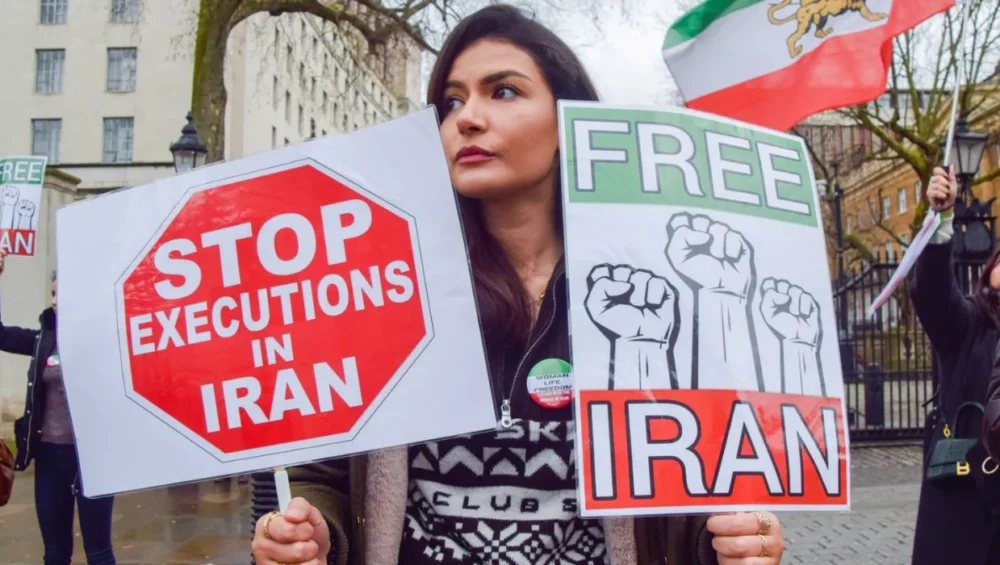
The case of Zahra Tabari, a 67-year-old electrical engineer and women’s rights activist sentenced to death in Iran, has become a stark symbol of the Islamic Republic’s deepening human rights crisis.
As United Nations experts and more than 400 prominent women worldwide urge Tehran to halt her execution, Tabari’s ordeal exposes not only systemic violations of due process, but also the increasingly gendered application of capital punishment in Iran. Her situation represents a common pattern which leads to the criminalization and death penalty punishment of women who engage in activism, or protest, or use symbolic forms of expression.
Iranian authorities must immediately quash Zahra Shahbaz Tabari’s conviction and death sentence. In mid-Oct 2025, a Revolutionary Court in Rasht sentenced her to death following a grossly unfair trial over alleged links to an opposition group according to an informed source. 1/3 pic.twitter.com/8r5dsvX24n
— Amnesty Iran (@AmnestyIran) October 30, 2025
Iran leads the world in executing women at the highest rate among all countries. The increasing number of data points together with global warnings creates an immediate need to assess judicial authority and Iran’s security legislation. The lasting effects of discriminatory legal systems against women.
A case that reveals systemic abuse
Zahra Tabari faced arrest during an April home raid, which took place without any official court authorization. The Iranian authorities accused her of working with the prohibited opposition group People’s Mujahideen Organisation of Iran (PMOI), which the government uses this charge to suppress political opposition. In October, a Revolutionary Court in Rasht convicted her of “armed rebellion” after a trial conducted via video link that reportedly lasted less than ten minutes.
According to her family and UN experts, the evidence used to justify the death sentence consisted of a piece of cloth bearing the slogan “Woman, Resistance, Freedom” and an unpublished audio message.
She was denied access to a lawyer of her choosing, held in solitary confinement for weeks, and pressured to confess—hallmarks of Iran’s security prosecutions. UN special rapporteurs concluded that the procedural violations were so severe that any resulting conviction was inherently unsafe and that her execution would constitute an arbitrary deprivation of life under international law.
Crucially, the experts stressed that international legal standards restrict the death penalty to the “most serious crimes,” defined as intentional killing. Criminalising women’s rights advocacy and symbolic expression as armed rebellion, they warned, amounts to a grave form of gender discrimination.
How many women has Iran executed?
The death of Mahsa Amini in 2022 sparked nationwide protests which led to a sharp increase in capital punishment executions throughout Iran during the past few years. According to Iran Human Rights (IHR), at least 1,426 people were executed in the first eleven months of 2025 alone, representing a 70% increase compared with the same period the previous year.
Among them were at least 41 women, a figure that places Iran far ahead of any other country in terms of executions of women.
The Islamic Republic of Iran has carried out hundreds of executions against women since it came into power in 1979. The total number of female executions remains lower than male executions, yet the execution rate per population and the types of offenses, which include morality violations, drug offenses, and national security threats, demonstrate how these practices specifically target women.
Human rights organisations estimate that over 200 women have been executed in Iran since 2010, with a marked acceleration since 2022.
Previous cases of women executed by Iranian authorities
Zahra Tabari’s case echoes a grim history. The year 2023 and 2024 brought multiple executions of women who faced trials that contained reports of torture and forced confessions, and denied access to legal defense. The courts found many people guilty of offenses including “enmity against God” (moharebeh), “corruption on Earth,” and ambiguous national security violations.
Women who participate in protest activities, ethnic minority activism, and gender equality advocacy work have started to encounter capital charges more often. Kurdish women have experienced the most severe impact from these attacks.
The case of Pakhshan Azizi, a Kurdish social worker now facing execution on similar charges, reflects this pattern. UN experts have stated that her sentencing appears to be linked solely to her humanitarian work with refugees in Iraq and Syria.
The first woman political prisoner in 14 years in Iran is facing imminent execution after a blatantly unfair appeal process that upheld her death sentence.
— Center for Human Rights in Iran (@ICHRI) January 9, 2025
Iran’s Supreme Court has upheld the death sentence for Pakhshan Azizi, a 40-year-old Kurdish humanitarian worker, and… pic.twitter.com/mlYLZ0ktki
Beyond individual cases, Iran’s history includes mass executions of women during political crackdowns, most infamously during the 1988 prison massacres, when thousands of political prisoners—including many women—were summarily executed. The state terror system from the past still continues to exist in the present day. According to survivors and advocacy organizations who study executions from decades ago.
The legal framework enabling executions
The legal framework of Iran contains embedded harsh regulations which target women. Under Iran’s interpretation of Islamic law, women face systemic discrimination in matters of inheritance, testimony, marriage, divorce, and child custody. The criminal justice system treats women with special vulnerability when it comes to charges based on morality, and severe penalties for national security threats.
The Revolutionary Courts have broad authority to decide cases through their interpretation of vague legal terms which include “enmity against God,” “armed rebellion,” and “corruption on Earth.”
These courts function in secrecy. They reject defendants’ rights to fair trials and base their decisions on intelligence reports instead of concrete evidence. Women activists face terrorism charges when they participate in activities such as protesting forced veiling, supporting gender equality, or backing protest movements.
The death penalty is further normalised by Iran’s frequent use of capital punishment for non-lethal offences, including drug-related crimes. Although some reforms were introduced in 2017 to limit executions for drug offences, recent data shows a renewed surge, with nearly half of those executed in 2025 convicted on such charges.
Why women’s activism is treated as a security threat
The Iranian government maintains a perspective which identifies women’s rights activism as a direct threat to its core ideological principles. The slogan “Woman, Life, Freedom” challenges both specific policies and the entire system of gender-based rule. The authorities use women’s activism with armed rebellion and terrorism to discourage group action through fear-based tactics.
The security protocols against gender dissent have transformed peaceful symbolic actions such as banner holding, message recording, and humanitarian work into criminal offenses. The UN experts determined this practice violates international human rights law because it constitutes gender discrimination. The treaty commitments of Iran face a violation through this action.
International response and its limits
The appeal which has received signatures from over 400 distinguished women including Nobel laureates and former government leaders demonstrates increasing worldwide anger. The world leads Iran as the country with the highest female execution rate. This has become a central issue for advocacy groups based in Europe and North America.
International pressure failed to stop the Iranian government from continuing its execution program. The UN systems provide documentation and moral authority but they lack the power to enforce their decisions. The sanctions against Iranian officials who commit human rights abuses have shown no impact on Tehran’s fundamental policies but they have made symbolic statements.