
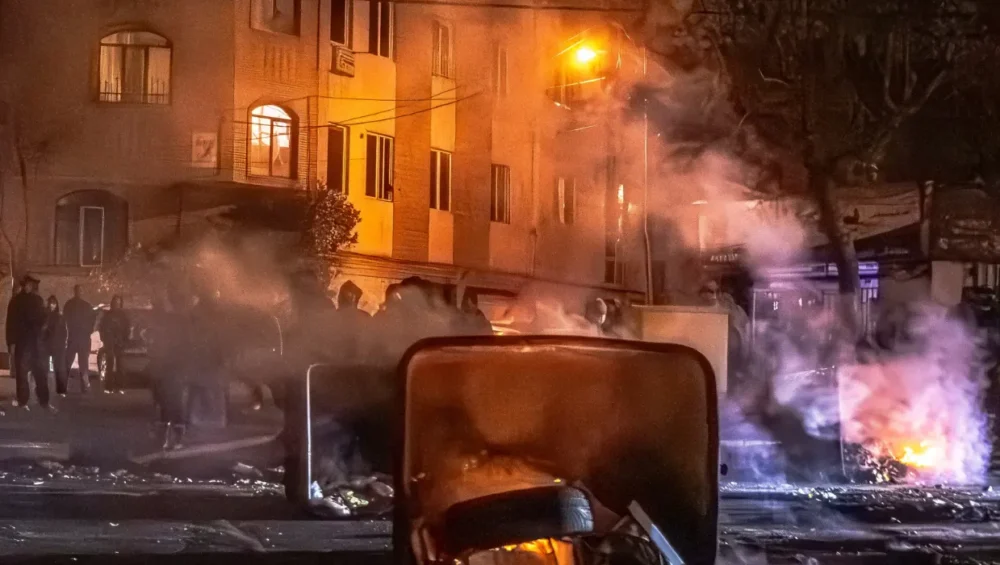
Reports of Iranian law enforcement sexually assaulting protesting Iranians, including a 16-year-old minor, have further escalated international concern regarding Iran’s response to its current round of nationwide protests. Iran’s handling of this recent spate of protests is accompanied by allegations of systematic abuse, torture, and violence, according to human rights organizations.
The Kurdistan Human Rights Network (KHRN) has reported that at least two arrestees in the western Iranian city of Kermanshah, a juvenile included, have complained of sexual abuse during the process of transportation by the riot police. The victims have been physically assaulted as well as subjected to sexual assault using batons, a phenomenon known as a form of humiliating torture by human rights organizations.
“These acts constitute torture under international law,”
said Rebin Rahmani of KHRN, noting that sexual violence by state agents is explicitly prohibited under the UN Convention Against Torture, to which Iran is a signatory. “The use of sexual assault against detainees, especially children, reflects an alarming level of impunity within Iran’s security apparatus.”
Children Targeted in a Climate of Impunity
The alleged abuse of a 16-year-old detainee not only raises severe implications regarding the Convention for the Rights of the Child but also because Iran signed this agreement in 1994. Internationally, under human rights, children are never to be detained, tortured, or abused sexually, even in times of emergencies.
Rights organizations have reported that children are becoming more entangled in the suppression of the Iran protests. During the uprising in 2022 that broke out over the death of Iranian woman Mahsa Aminie in the morality police’s custody, at least 68 children had been killed, Amnesty International reported.
In the current turmoil, concerns have been raised by activists that children are once again being rounded up en masse in mass arrests, without supervision and without transparency. Internet shutdowns have made verification extremely difficult.
Scale of Arrests and Deaths in Custody
Human rights organizations estimate that over 20,000 were arrested since demonstrations restarted at the end of December. The HRANA human rights news agency, which is US-based and operates with a staff inside the country, reports that at least 3,766 people were killed and some other nearly 9,000 under investigation, which, if confirmed, would represent one of the deadliest crackdowns in Islamic Republic history.
Deaths in custody remain a concern of particular gravity. The Kurdish rights group Hengaw reported that a 40-year-old protester by the name of Soran Feyzizadeh died as a result of torture subsequent to his detention in early January, with his body showing extensive injuries consistent with severe beatings.
“His body was barely recognizable,”
said Awyar Shekhi of Hengaw, adding that Feyzizadeh’s family was forced to pay a sizeable ransom to retrieve his body—an alleged practice that rights groups say amounts to extortion and collective punishment.
Such cases echo earlier patterns. The Abdorrahman Boroumand Center for Human Rights in Iran has documented dozens of deaths in custody over the past two decades, often accompanied by official denials or implausible explanations such as suicide or illness.
Targeting of Women and Pregnant Protesters
The impact of this crack-down has been more on the female population. According to Hengaw, Sholeh Sotoudeh, who was pregnant and hailed from the town of Langarud, was shot along with her unborn child when the armed forces started firing on the protesting groups in northwest Iran on 10 January.
As of August, at least 549 protesters had been transferred, including 51 women, to the central prison in Yazd, according to the Abdorrahman Boroumand Center, sparking concerns of overcrowding, violence, and lack of medical care. Former detainees have also cited sexual assault, forced confession, and threats of rape in order to gain confessions in interrogation sessions.
Sexual Violence as a Tool of Repression
Rape victims have been reporting abuses dating back to Iran. Some of the victims made their cases known during the 2022 Iran protests. Those accused testified before journalists and rights organizations of raping them blindfolded during interrogation sessions. This was a tactic of extracting confessions and dissuading others from participating in Iran protests.
International law scholars consider that when these actions are widespread or systemic, they might amount to crimes against humanity. Although an independent inquiry by international bodies has not been permitted by Iranian authorities, UN special rapporteurs have voiced consistent warnings that the sequence of violations suggests that they are state-sponsored, not lone actions.
Global Silence and Calls for Accountability
Despite mounting evidence, accountability remains elusive. Iran has consistently rejected UN fact-finding missions and dismissed allegations as foreign propaganda. Families of victims face intimidation, restrictions on funerals and threats if they speak publicly.
“As street protests wind down, the risk to detainees actually increases,”
said Roya Boroumand, executive director of the Abdorrahman Boroumand Center.
“History shows that torture and deaths in custody often occur away from public view, once the cameras are gone.”
Human rights groups are urging the international community to push for targeted sanctions, universal jurisdiction cases, and sustained diplomatic pressure. Without accountability, they warn, sexual violence, torture and deaths in custody will continue to be used as instruments of state control.