
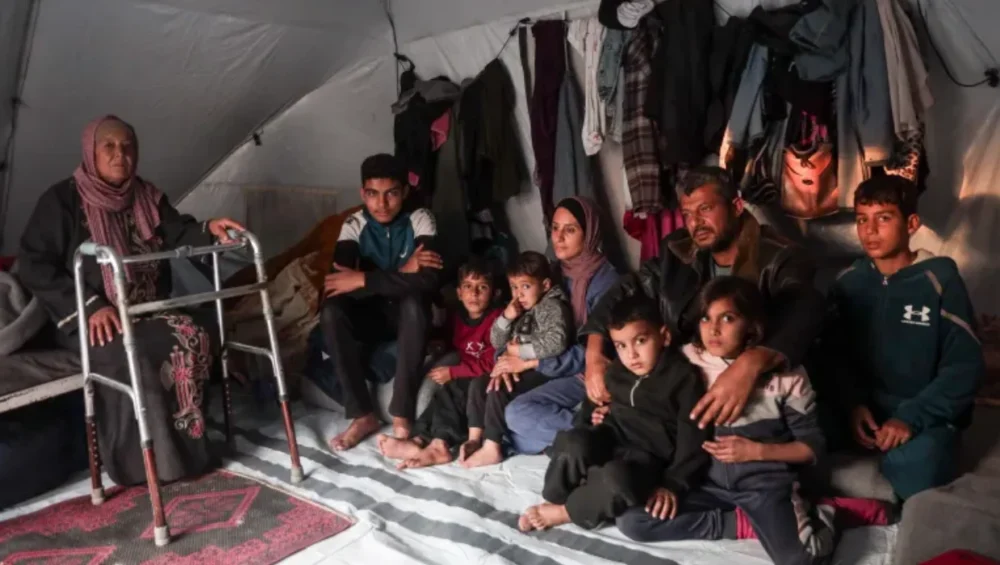
Piled into one tent in a United Nations-managed school in the center of Gaza City, Alaa Alzanin, wife, five children, 71-year-old mother, and younger sister huddle together to survive in the aftermath of the loss of their dwelling in the Beit Hanoon area during the conflict between Israel and the Palestinians. This is the eighth time that the family has had to be relocated.
At 41, Alzanin cannot sustain his family. A former day laborer in infrastructure and farming, he has been left unemployed, like hundreds of thousands of others across the Gaza Strip.
“Now I have no work, I can’t provide for my family,” he told Al Jazeera.
“I used to plough the soil, plant tomatoes and cucumbers, spray pesticides… now, I have nothing. This is inhumane.”
How are children paying the price of the siege and war?
Majed Hamouda, 53, from Jabalia in northern Gaza, is another victim. He has polio, and his wife is a thalassaemia carrier. With five children to support, Hamouda relies on government aid, which has stopped since the war began. He recounts asking his young son to collect plastics and rubbish to sell so the family can eat.
“My little son Yaqoub was a top student, winning a ‘Little Scientist’ award for experiments at school,”
Hamouda said.
“Now, I watch him burn plastics to cook. We are like dead people, but not buried yet. Even dogs live better lives than us.”
Why is Gaza facing widespread hunger and poverty?
After more than two years of war, Israel’s attacks have left the Gaza Strip nearly destroyed. The United Nations’ World Food Programme (WFP) warns that supplies entering the territory are far below the daily target of 2,000 tonnes. Only two crossings into Gaza are open, and restrictions by Israel prevent sufficient delivery of food, fuel, and medical supplies.
The crisis has reached unprecedented levels of despair as people continue to go hungry across #Gaza.
— UNRWA (@UNRWA) June 10, 2025
🚨 Over 2.700 children under 5 diagnosed with acute malnutrition in late May
🏥 Only 1 medical point partially functional in North Gaza
⛽ Fuel stocks critically low
Humanitarian… pic.twitter.com/CqxghXJhyx
The mid-October release from the Palestinian Central Bureau Statistics reported that the unemployment rate was at an unprecedented 50% in Palestine, with a total of 80% in Gaza. Over 550,000 people remain unemployed. The UN Conference on Trade and Development reported that Gaza’s GDP has reverted to what it was in 2010, while its GDP per capita reverted to what it was in 2003, undoing more than 20 years of development.
The worst hunger in #Gaza is easing, but gains are fragile as acute food insecurity remains widespread.
— World Food Programme (@WFP) December 19, 2025
1.6M people still face high levels of hunger as we head into the new year.
Now is the time to double down on delivering food and vital support.
⏩Swipe to learn more⏩
How much has the economy collapsed after the war?
Before the outbreak of war, Gaza’s economy was weakly based, with growth under way. There were business, industrial, and tourism ventures, most of which involved SMEs. Agriculture covered most requirements for the population.
In August, Human Rights Watch criticized the US-backed Gaza Humanitarian Foundation (GHF) aid distribution system and found that Israeli forces routinely opened fire on Palestinians seeking food, killing hundreds, in acts that amount to war crimes. pic.twitter.com/3bi6kxVdxU
— Human Rights Watch (@hrw) December 10, 2025
Now, the GDP has plunged by 83% in 2024 and 87% over two years to $362 million. GDP per capita stands at $161 — among the lowest globally. The private sector, once 52% of employment, has been decimated, and the government estimates that 90% of all sectors, including housing and infrastructure, have been destroyed.
Are international aid efforts enough to address the humanitarian crisis?
Gaza’s government has plans to revive the economy and create jobs, but this depends on multiple factors, including unrestricted access to raw materials and production inputs through border crossings. Temporary employment programs for youth and graduates, rebuilding productive sectors, and supporting SMEs are essential, according to Ismail al-Thawabta, head of Gaza’s Government Media Office.
“Relief alone is not enough,” he said.
“We must rebuild industry, agriculture, and services to create real jobs and reduce dependence on aid. Total economic losses are estimated at $70 billion.”
What are families like the Alzanins facing daily?
Alaa Alzanin and his pregnant wife Mariam receive some food through aid programs, but it is not enough to meet nutritional needs.
“We eat hot meal deliveries, but it is not nutritious. I am three months pregnant and losing my
teeth from lack of calcium,” Mariam said.
“We see food in the markets, but we cannot afford bananas, apples, fish, or eggs. The children ask for food we cannot provide — it is heartbreaking.”
Are basic human rights being respected in Gaza?
The destruction of homes, mass displacement, unemployment, and hunger in Gaza raises urgent human rights concerns. Access to adequate food, housing, healthcare, and economic opportunity are protected under international human rights law. The ongoing blockade, combined with the devastation caused by the war, leaves millions of Gazans vulnerable and deprived of their basic rights.
Can Gaza recover without lifting restrictions and ending the siege?
Rebuilding in Gaza requires both international and local initiatives. Full opening of crossings to allow goods in without restriction, along with long-term investment in the productive sectors, are what is needed to bring livelihoods and dignity back. As long as these basic requirements are not satisfied, families like the Alzanins will be doomed to the vicious circle of poverty and malnutrition, displacement, andwithout an end in sight.