
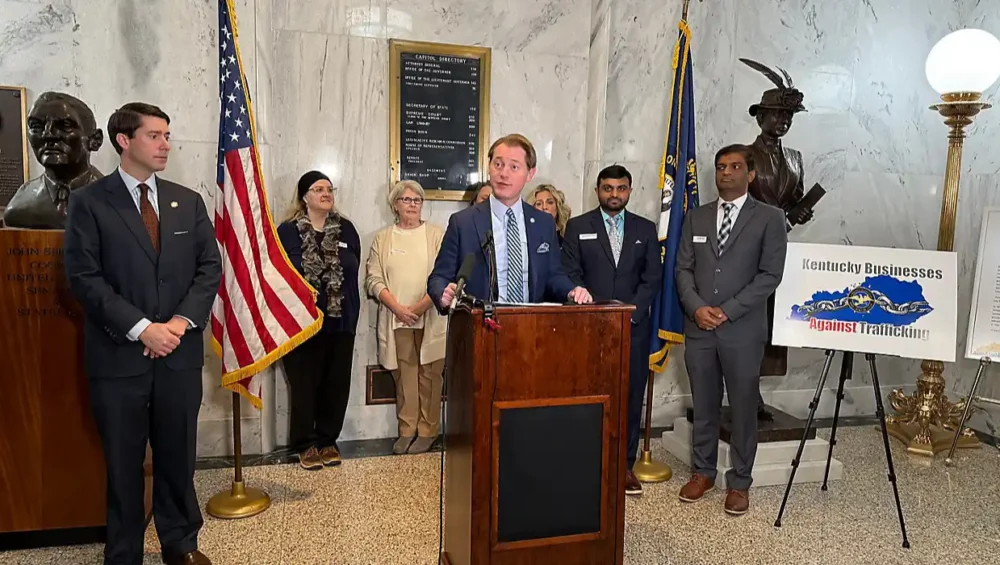
Kentucky has entered a new phase in its response to human trafficking with the launch of a statewide coalition designed to move beyond awareness campaigns toward coordinated intervention. The initiative emerged through an executive order issued by Governor Andy Beshear and publicly championed by First Lady Britainy Beshear in March 2026. Officials describe the coalition as a multi-agency framework bringing together law enforcement, health professionals, advocacy groups, and survivors to strengthen prevention and victim support across all counties.
The policy move follows several years of escalating concern among state agencies and national monitoring organizations. Data reviewed during legislative debates in 2025 suggested that trafficking networks were adapting quickly to digital communication tools and interstate transportation routes. By forming a centralized coalition, state leaders aim to bridge gaps between local enforcement efforts and social service networks that often operate independently.
Executive order and statewide coordination
The executive order established a formal structure designed to coordinate responses across Kentucky’s 120 counties. Authorities emphasized that trafficking patterns rarely remain confined to urban centers and often involve rural communities connected through highway systems. Officials argued that fragmented local responses had previously limited the state’s ability to identify and respond to emerging threats.
Public safety leaders involved in the coalition have stressed the importance of integrating intelligence sharing and standardized training. The initiative intends to create clearer communication channels between investigators, healthcare workers, and community organizations that may encounter victims in different settings.
Policy momentum built during 2025 debates
Momentum behind the coalition gained strength during legislative discussions in 2025 focused on expanding reporting obligations and strengthening victim assistance programs. Lawmakers cited growing evidence that trafficking incidents were increasing nationwide, prompting renewed scrutiny of state preparedness. Kentucky’s policymakers framed the new initiative as a continuation of those reforms rather than a separate policy effort.
Advocacy groups also played a role in shaping the program’s design. Survivor testimonies during hearings influenced how the coalition structured outreach programs, particularly those addressing early warning signs and prevention strategies among youth populations.
Scope of trafficking challenges across Kentucky
Understanding the scale of the issue has been central to shaping the coalition’s objectives. Analysts studying hotline data and law enforcement reports have noted consistent patterns involving both sex trafficking and labor exploitation in the state.
Hotline data and case patterns
Reports compiled by national hotlines and regional agencies have indicated that Kentucky has remained among states with significant trafficking activity relative to population size. Authorities recorded hundreds of signals and confirmed cases in recent years, revealing a mix of exploitation types occurring in private residences, businesses, and online environments.
Experts examining the data highlight the age patterns often associated with victim recruitment. Adolescents and young adults appear particularly vulnerable, especially when grooming or manipulation occurs through social media channels. Investigators note that traffickers frequently exploit economic instability or family-related pressures to maintain control over victims.
Rural and urban distribution of incidents
Law enforcement officials have observed that trafficking networks operate across both metropolitan areas and rural communities. Interstate corridors such as those connecting neighboring states play a significant role in facilitating movement between locations. These transportation routes have drawn attention from investigators who see them as logistical pathways used by organized networks.
Community organizations in rural counties have reported difficulty identifying cases due to limited resources and fewer specialized services. The coalition’s statewide design attempts to address this imbalance by ensuring smaller jurisdictions receive training and access to coordinated support systems.
Survivor perspectives shaping coalition priorities
One of the defining aspects of the new coalition involves incorporating the insights of survivors who have experienced trafficking firsthand. Advocates argue that policy responses often overlook the complexity of recovery and long-term protection needs.
Survivor leadership in program development
Advocacy leaders participating in the coalition emphasize that survivor input helps identify warning signs that might otherwise remain unnoticed. Survivors involved in program design have described patterns of grooming, coercion, and gradual control that often precede trafficking situations. Their experiences are expected to guide education campaigns and prevention programs targeting schools and community organizations.
Support groups have also underscored the importance of stable housing and employment opportunities for individuals leaving trafficking environments. By integrating these priorities into the coalition’s strategy, policymakers aim to reduce the risk of victims returning to exploitative situations.
Expanding recovery and reintegration support
Recovery programs associated with the initiative focus on counseling services, vocational training, and long-term reintegration. Social workers participating in the coalition argue that addressing trauma requires sustained assistance rather than short-term intervention. Programs designed in 2025 pilot efforts demonstrated improved outcomes when survivors had access to structured support networks.
Authorities believe these approaches may also encourage more victims to come forward, particularly when they see pathways toward stability after leaving trafficking environments. Increased reporting could ultimately improve data accuracy and enforcement outcomes.
Legislative framework strengthening anti trafficking measures
The coalition operates alongside legislative reforms introduced in recent years aimed at strengthening accountability and prevention mechanisms. Lawmakers have emphasized that the policy environment surrounding trafficking has evolved rapidly.
Laws adopted during 2025 reforms
Legislation approved in 2025 introduced additional requirements for training within industries considered high risk for encountering trafficking victims, including hospitality and transportation sectors. Lawmakers argued that these environments frequently intersect with trafficking operations, making employee awareness a key component of prevention.
The new laws also expanded penalties for trafficking-related offenses involving minors. Supporters of the measures said stronger legal consequences could deter networks operating within or passing through the state.
Integration with federal initiatives
State officials have aligned several programs with federal anti-trafficking strategies launched or updated in 2025. Training modules used by the coalition draw from national frameworks designed to help professionals recognize signs of exploitation. Partnerships with federal agencies also aim to improve coordination when cases involve interstate networks.
Observers note that federal collaboration may strengthen Kentucky’s ability to track patterns extending beyond state borders. Cross-jurisdictional investigations often require shared intelligence and unified legal approaches.
Implementation challenges and operational realities
Despite broad support for the initiative, analysts caution that translating policy commitments into measurable outcomes will require sustained investment and coordination.
Resource constraints across counties
Kentucky’s diverse geography presents logistical challenges for implementing a consistent response statewide. Rural counties, in particular, may struggle to maintain specialized services due to limited funding and staffing. Experts involved in the coalition have acknowledged that expanding access to shelters and counseling services will be a gradual process.
Funding decisions made during annual budget cycles will influence the coalition’s ability to maintain programs. Policymakers have indicated that evaluating early results will play a role in determining future allocations.
Measuring progress and prevention outcomes
Determining whether the coalition successfully reduces trafficking activity remains complex. Underreporting has long been recognized as a major obstacle in assessing the scale of the issue. Analysts note that increases in hotline calls or reported cases could initially reflect improved detection rather than an actual rise in incidents.
Researchers working with state agencies have proposed tracking additional indicators such as victim recovery rates, prosecution outcomes, and community awareness levels. These measures may provide a broader picture of how effectively the initiative addresses the underlying causes of trafficking.
National context influencing Kentucky’s approach
Kentucky’s strategy reflects broader national efforts to shift from awareness-focused campaigns toward coordinated enforcement and prevention models. Several states have introduced similar task forces or coalitions in response to evolving trafficking patterns observed during the past decade.
Regional collaboration and interstate concerns
States connected through major highway networks often face overlapping trafficking challenges. Law enforcement agencies in the Ohio River Valley region have increasingly coordinated investigations, recognizing that trafficking operations rarely respect state boundaries. Kentucky’s coalition intends to strengthen those relationships through shared training and communication.
National organizations tracking trafficking trends reported in 2025 that case numbers were rising across multiple regions, particularly where online recruitment and travel infrastructure intersect. These patterns reinforced the urgency of regional collaboration.
Growing emphasis on prevention strategies
Public policy discussions now place greater emphasis on prevention rather than solely responding after crimes occur. Education programs targeting young people and community awareness initiatives form part of that shift. Authorities believe early recognition of grooming behaviors could reduce the likelihood of exploitation escalating into trafficking situations.
The integration of survivor perspectives into policy design reflects this preventive approach. Advocates argue that understanding how trafficking begins is essential for disrupting recruitment pathways.
Kentucky’s evolving strategy illustrates how governments increasingly combine law enforcement coordination, survivor advocacy, and legislative reform in confronting a complex social challenge. As the coalition begins its work across communities ranging from urban centers to rural counties, attention turns to whether sustained collaboration can transform awareness into measurable change, revealing how societies adapt when confronting crimes that often remain hidden yet deeply consequential.