
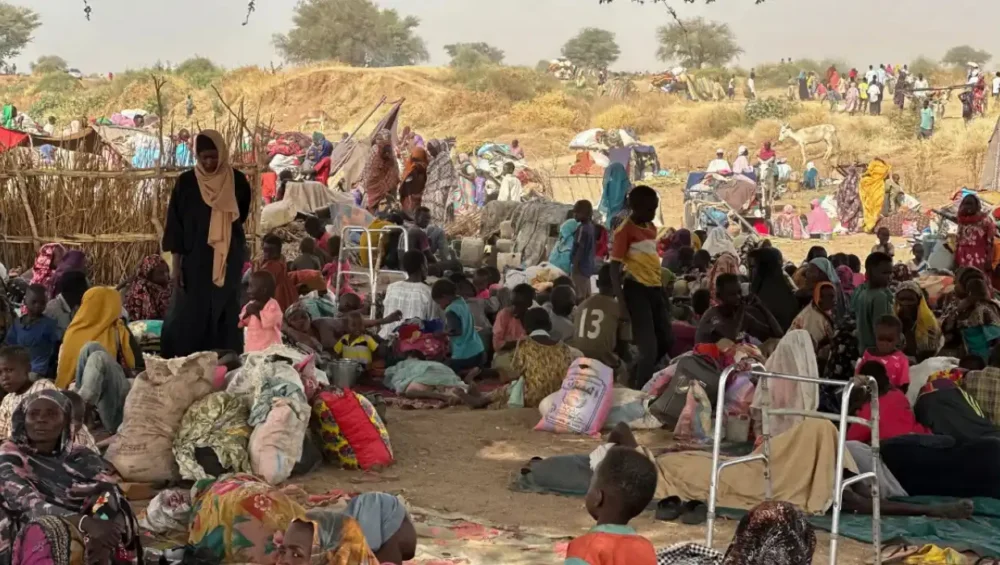
In Sudan 2025, forced displacement has been narrowed down as the war spreads to various regions, especially to the Darfur, Khartoum, South Kordofan and the Blue Nile. The Sudan Armed Forces vs. the Rapid Support Forces are still fighting and splitting the territory control, attracting tribal militias and local armed groups. Ordinary people caught in fading front lines cite constant shelling, air attacks and targeted raids that continuously drive people out of the areas.
Humanitarian observers observe that displacement trends have become more unpredictable than in 2024 as population flows are now becoming large and sudden waves driven by sudden offensives. Local civil society groups report on the pace at which violence is escalating in the conflicted regions as they claim how whole villages are being emptied overnight.
Displacement Scale And Demographic Impact
Its internally displaced population is at an all time high in 2025, with an estimated number of over four million newly displaced in 2021 according to the UN agencies. Numerous of them are in millions of people uprooted earlier by the war. Families are split with men left behind to guard property or join the local defense forces, leaving women and children to refugee camps.
Conditions In Overcrowded Settlements
Crowding is becoming the greatest stressor on temporary shelters where clean water, sanitation, and healthcare are not readily available to stimulate disease outbreaks. In early 2025, Medecins Sans Frontieres sounded the alarm that multiple displacement locations were experiencing the increase in cases of cholera and measles because of lack of medical supplies.
School Disruptions And Loss Of Livelihoods
The education of children is also greatly hampered with schools being destroyed or turned into shelters to the displaced families. Farmers who have abandoned productive lands around Gezira State allege to have missed whole harvesting periods and this has put an extra strain to the already fragile food security.
Vulnerability Of Marginalized Groups
Communities of ethnic minorities are particularly more susceptible to forced evictions and special attacks, especially in Darfur, where the local leaders state that the violence is a re-enactment of previous patterns of dispossession but with added density.
Drivers Of Displacement Across Conflict Zones
There are several reasons that keep increasing displacement in Sudan. Forced movement is a tactic that is most frequently employed by armed groups in the efforts to depopulate regions, undermine the support bases of enemy groups, or gain control over roadways and supply lines. In mid-2025, satellite photographs depict general incineration of residential properties, which fits the trends of forced clearance actions.
The crisis is heightened through environmental pressures. The race to a limited land where pastoralists graze and water bodies has resulted in new conflicts between farmers and pastoralists. Droughts in some areas in North Darfur have exacerbated the situation and forced more civilians to move towards temporary camps or into border areas.
Systematic Humanitarian Aid Blockades
Aid blockades present a humanitarian crisis level to Sudan in 2025. Important supply routes linking central Sudan to Darfur and Kordofan are often blocked by military checkpoints, landmines or unlicensed local levies by armed groups. According to relief agencies, access routes periodically have been blocked by state and non-state forces as a result of either security factors or bureaucratic reasons holding up emergency operations.
Impact On Relief Operations
There is a lot of danger to humanitarian convoys transporting food, medical supplies, and emergency shelter supplies. Aid organisations complain of ambush, seizure of vehicles and personnel detention. In early 2025, on two occasions, in February and April, field team attacks caused several international NGOs to temporarily halt operations in Darfur.
Threats To Aid Workers
The relief workers are working more and more at the risk of kidnapping or forcible recruitment. At the beginning of the year, UN security briefings said that it was one of the most hostile environments to aid operations worldwide.
Shortages And Rising Mortality
Due to such blockades, the supply does not reach the numerous communities at high risk, which increases the levels of malnutrition. The rise in preventable mortality, particularly in children under five is mentioned by local medical practitioners.
International Diplomatic And Policy Challenges
The staffing of diplomatic missions to ensure unhindered access to humanitarian aid is still being obstructed by the flaws in the UN Security Council and regional interests. Demands of humanitarian corridors have been on the rise but are not well enforced on a regular basis. Humanitarian partners and donors were left without confidence as there were failed attempts to negotiate a ceasefire early in 2025.
Fragmented Coordination Among Actors
Relief groups have issues of disjointed communication between various military units and the local governments. Absence of a centralized management also adds to inconsistent authorization and unexpected prohibitions that interrupt supply chains.
Geopolitical Tensions
Most of the regional powers that engage in mediation have conflicting strategic interests, which restrict their capacity to assume a concerted force on the warring parties. Analysts observe that the unstable alliance changes also make it more difficult to stabilize the access routes to areas of conflict.
Broader Humanitarian And Security Implications
This overlap of forced displacement and aid blockades exacerbates the humanitarian disaster in Sudan and extends the structural collapse of the critical systems. There is a collapse in the provision of public health services due to the depletion of medical stocks and flight to unsafe territories by healthcare workers. Water facilities are destroyed, aggravating sanitation issues in the places of displacement.
The social networks are an element of weakened social communities as they are divided into various displacement areas. Former dispute-resolution systems become less effective as migration upsets the local systems of governance.
Regional Spillover Risks
Transnational migration creates more pressure on the immediate neighbors and Chad, South Sudan and Egypt have been faced with increasing numbers of refugees. Camps at Sudan-Chad have been reported to experience overcrowding and lack of resources thus creating the fear that tensions might cross over into local conflicts.
Groups, which are armed and operate around border areas, are also security threats since some movements seek to recruit among the refugees. Refrains begun by regional authorities, such dynamics may disrupt weak political environments around Sudan.
Obstacles To Peace And Reconstruction
Constant limitations on humanitarian aid stand in the way of trust-building in the interest of peace efforts. Populations who have been displaced can not safely go back without the assurance of security, reestablished services and clearance of unexploded ordnance. In the meantime, the mass demolition of houses and the marketplace impedes the economic recovery and rebuilding opportunities.
The reintegration programs are still a limited part since fighting does not allow proper planning or implementation of the program. Settlements that lost agricultural fields and animals have long-term problems in terms of reconstruction of livelihoods, despite the fact that hostilities will end.
Emerging Questions Amid Sudan’s 2025 Crisis
The forced displacement in Sudan 2025 is informing the broader direction of the conflict, with millions of displaced civilians facing the growing instability with less and less backing. The continued aid blockages provide a cause of concern whether the crisis will transform to become a prolonged humanitarian crisis with regional effects. The balancing act of decision-makers between the conflicting demands of military policy, humanitarianism, and diplomatic talks will be the decisive element in the coming months to decide whether Sudan will be heading to de-escalation or further fragmentation.