
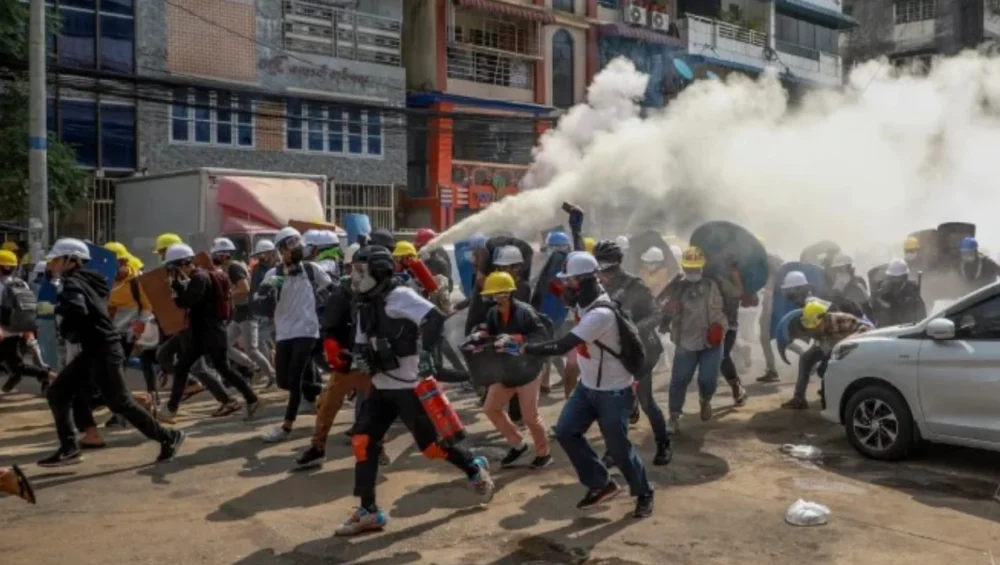
The post-coup situation in Myanmar became more and more violent until 2025 and formed one of the most unstable crises in Asia. The military coup of February 2021 disrupted the governance of the country and created a deep-rooted conflict between the junta and a fast-growing opposition. United Nations surveillance reveals over 6,000 deaths of civilians since the coup, 1,200 of whom are the children whose deaths were registered by the end of 2025. Displacement was also unprecedented with 3.5 million civilians displaced, especially around Sagaing, Magway and Chin.
Airstrike operations escalated with the junta increasing their application of aerial bombardment to recover lost territory to the resistance forces. Verified UN communications recorded one single incident in Sagaing in September 2025 which claimed the lives of 187 civilians. These attacks were marked by a consistent pattern of civilian infrastructure, market, and displacement camp attacks.
Increasing resistance restructured the territorial relationships, and by the end of 2025, the countries were under control of the people’s defense forces and ethnic armed groups that occupied around 60 per cent of the country. The growth stimulated increased reprisals. Human Rights Watch recorded 1,200 arbitrary arrests in the same year with more than 200 individuals after the torture being reported dead. The resurgent junta strategy of the four cuts (reducing food, funds, intelligence and recruits) left almost 2 million civilians in the situation of artificial scarcity.
Patterns of civilian targeting
The targeting of civilians expanded to all key fronts of the war up to 2025. According to independent estimates by the monitors, there have been 1, 500 extrajudicial execution of junta forces throughout the year to which many of the incidents included deliberate confusion of non combatants with non-combatants to the resistance. It was also a case of 80 percent civilians among 500 recorded hits that used unguided aerial munitions.
The UN Special Rapporteur Tom Andrews declared that the military is using hunger and fear against its own citizens pointing out to the fact that there is evidence of systematic sexual violence. There were at least 300 confirmed rape cases in Kachin, Shan, and Rakhine which were frequently more often than raids on the villages, displacement settlements.
With nationwide drafts being declared by the junta in early 2025, forced conscription grew enormously. It was estimated that more than 100,000 civilians were forcefully recruited. The policy hastened flight to borderlands and was a contributory factor to defections in the armed forces. Mass internet blackouts were also used as an intentional weapon, 70 percent of the population was impacted by almost 200 cumulative days of blackouts in 2025 and communication within resistance-controlled territories was paralyzed.
Airstrike and bombardment campaigns
In 2025, military aviation was intensified and about 4000 sorties were recorded. Almost forty percent of these attacks were against civilian facilities such as schools, clinics, and places of worship. Included in the reported fatalities were sagaing and Kayah that made close to 60%. It was reported by independent legal experts that cluster munitions were still being used even though they were banned in international law. Humanitarian agencies sounded the alarm on repeated occasions that the patterns of bombing showed that there was more than battlefield pressure, but a campaign of depopulation of the resistance zones.
Detention and torture practices
Prisoner conditions in the prisons of the junta continued to be in dire states since there was an influx of political detentions. By the end of 2025 over 25,000 political prisoners were imprisoned, and 500 of them died due to torture or negligence. Detainees released have recorded that women constituted almost 40 percent of the population in the prisons where they were subjected to sexual violence and forced labor as a form of punishment. Patterns are documented in the form of nighttime raids and disappearances especially in Yangon and Mandalay.
Ethnic minority repression surge
In 2025, ethnic areas experienced one of the most devastating campaigns. Rakhine experienced the renewal of scorched-earth operations following the Arakan Army achievements such as the burning of over 500 villages and displacement of 1.2 million civilians. Shan and Kachin areas were under constant shelling and independent mapping revealed that 50,000 houses had been destroyed during 12 months.
Emerging chemical weapon allegations
Reported losses of huge territories by junta forces, caused what observers termed as desperate escalation. By October 2025, the Organisation for the Prohibition of Chemical Weapons confirmed limited use of chemical agents in Karenni, the first formal confirmation of their usage in the conflict and redefined the pressure on the regime at the international level.
Rohingya and cross-border vulnerabilities
Rohingya communities have not been captured because fresh sweeps of expulsions have been directed towards 200,000 Rohingya people towards Bangladesh in 2025. At least 150 refugees died in shelling on the border selling Cox Bazar settlements, which is indicated as a continuous turmoil of the border. Bangladesh officials complained that humanitarian ability was at critical levels.
International response and sanctions
The attempt to press the junta was at a deadlock up to 2025. There was also no quantifiable improvement in the improvements of the five-point consensus of ASEAN as dialogue commitments were still ignored by the junta. Myanmar lost entry to any of the highly ranked ASEAN summits but member states were still divided. India only kept selective involvement using the border security and risks of insurgency spill over.
Multilateral actions and vetoes
The United States and European Union broadened the sanctions, labeling over 500 organizations and blocking an approximated 1 billion in foreign assets of the military conglomerates MEHL and MEC. The efforts to promote Security Council resolutions collapsed three times because of the veto of China and Russia who demanded non-interference and pointed out the worries regarding the destabilization of the region.
Humanitarian access limits
Humanitarian players were closely constrained, and 80% of the aid requests were rejected. UN officials had sounded an alarm over an imminent civilian disaster as food insecurity increased, particularly in those regions that rely on cross-border food supply channels. On-ground presence was also decreased because of security concerns to international agencies.
Humanitarian and economic fallout
The humanitarian indicators worsened in 2025 in Myanmar. In all, the number of individuals in need of aid was about 18.6 million, and there were 3 million cases of acute food insecurity. The rates of malnutrition in children rose to 15, which is more than twice the level before the coup. Conflict-ridden regions suffered collapse of education systems and 70 percent of schools in the country were still in the shutdown and 2 million children were out of classrooms in perpetuity.
The economic downsizing continued, and the GDP decreased by another 15% in 2025. Income in the major industries like jade, natural gas and timber decreased by almost half, weakening the financial ability of junta. The black market value of the kyat dropped to 10, 000 to every US dollar, a 400 percent depreciation of the kyat compared with the coup.
Displacement and refugee flows
Mass relocation was established. In Thailand and India, there were over 1 million refugees with each country, and about 800,000 stayed in informal camps that were near the border. Cross-border humanitarian organizations approximated that 20 percent of need was being fulfilled as junta rules and logistical blockade were strict.
Resistance and governance alternatives
Parallel governance structures solidified across opposition-controlled regions. The National Unity Government administered local services, coordinated taxation generating roughly $200 million annually, and expanded judicial and educational networks. Resistance forces adopted drone capabilities extensively, downing more than 100 junta aircraft in 2025. Urban sabotage campaigns disrupted major transit corridors, with rail line disruptions affecting up to 50% of operations nationwide.
Escalating violence and repression against civilians in Myanmar post-coup underscores a crisis shaped by territorial fragmentation, political isolation, and worsening humanitarian collapse. As shifting alliances redraw power structures and international leverage remains uncertain, the question of whether the military’s grip weakens further or external actors cement new realities continues to define the conflict’s unresolved trajectory.