
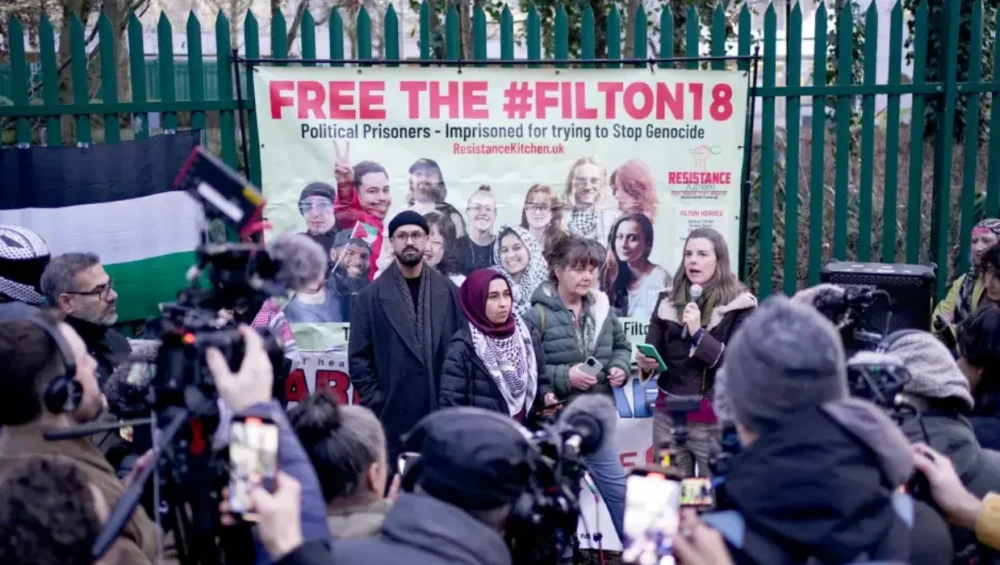
The acquittal of the six Palestine Action activists who were charged with the offense of aggravated burglary of the British defense firm Elbit Systems has rekindled the debate on the United Kingdom’s toughening stance towards political protest. Despite the jury acquitting the defendants of the most serious charges and failing to reach a verdict on charges of criminal damage, the case has highlighted what critics have branded as a
“systematic attempt to deter political protest.”
Prolonged Pretrial Detention Raises Due Process Concerns
The six defendants faced lengthy pre-trial detention, with some being detained for more than 500 days, or over twice the recommended limit by the Crown Prosecution Service (CPS). The human rights movement argues that this undermines basic legal principles and can be considered a form of punitive incarceration before trial.
In a letter to Human Rights Watch, the CPS defended the delays on the basis that judges have the discretion to extend detention periods provided that “due diligence and expedition” on the part of prosecutors can be shown. Legal experts, however, say that this is becoming a regular practice and that safeguards may be being undermined in politically sensitive cases.
Dozens More Protesters Still Await Trial
Over 20 Palestine Action activists are in legal limbo, many of whom have been detained beyond legal limits. One of them is Heba Muraisi, who is a 31-year-old lifeguard and florist by profession. She went on a 72-day hunger strike to express her discontent with her detention as well as the UK government’s policy on Gaza.
Muraisi has become a symbol of an overarching concern that activists are being kept in harsh detention conditions as a deterrent.
UN Experts Warn Against Criminalizing Political Dissent
In fact, last year, special rapporteurs and human rights experts at the United Nations publicly expressed their concern regarding the UK’s counter-terrorism policies being used to address political protests. The experts expressed that such measures may lead to the criminalization of peaceful advocacy and undermine the protection of basic human rights to expression, association, and assembly. The experts also expressed that equating political protest with terrorism may set a dangerous precedent in democratic societies, where dissent is a cornerstone to democratic accountability.
Terrorist Designation of Palestine Action Intensifies Crackdown
In July 2025, the UK government declared Palestine Action a terror organization, which drew widespread condemnation from civil liberties organizations due to its disproportionate and political nature. Since the declaration, over 2,700 peaceful protesters have been arrested under terror laws, including those who were holding placards that read, “I oppose genocide, I support Palestine Action.”
The declaration is currently being challenged in the High Court, with a ruling imminent. The declaration has been criticized as an unprecedented extension of counter-terror laws into the realm of domestic political action.
Systematic Restriction of Protest Rights
These developments are part of a larger trend of increasing restrictions on protest in the UK. This trend has been well-documented by Human Rights Watch in their report Silencing the Streets: The Right to Protest Under Attack in the United Kingdom.
Instead of rolling back the restrictive laws that the previous government had implemented, the current government has only added to these by introducing further measures that allow the police to extend their powers of restriction on protest, which has caused a degree of alarm in the country.
Missed Opportunity for Meaningful Legal Reform
The government’s independent review of Public Order and Hate Crime Legislation was anticipated to address the issues that have been raised by lawmakers, civil society groups, and international observers. However, it has become clear that the review excludes the use of counterterrorism legislation against protesters. It is believed that this is a deliberate avoidance of the most controversial and consequential issue. The exclusion of this issue is believed to be a missed opportunity to restore confidence in the UK’s commitment to democratic norms and legal proportionality.
Chilling Effect on Democratic Participation
Legal scholars and civil society organizations warn that the cumulative effect of prolonged detentions, mass arrests, and terrorist designations is a chilling effect on political participation. Activists, journalists, and ordinary citizens may increasingly self-censor out of fear of severe legal consequences, undermining the democratic function of protest as a tool for accountability.
.