
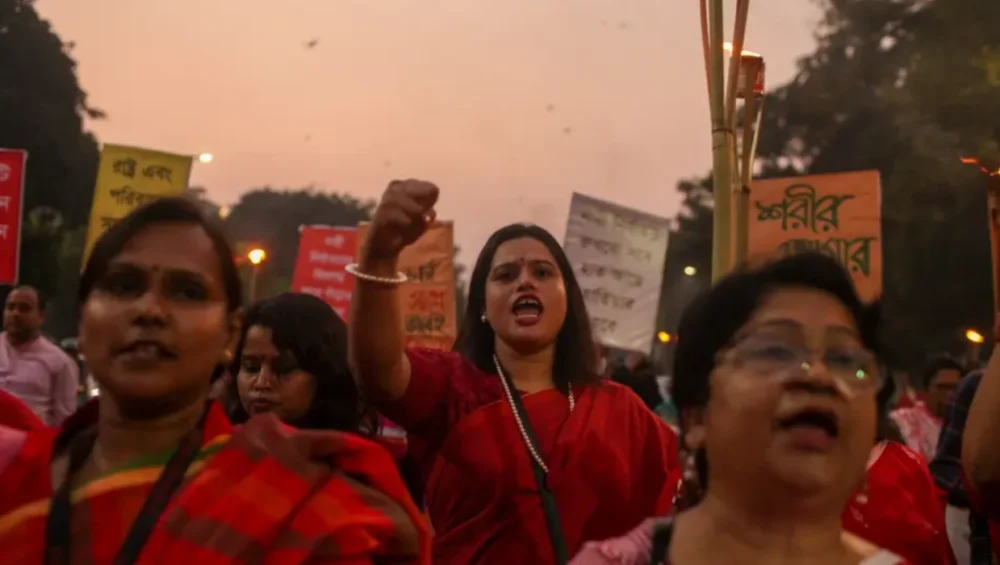
When Bangladesh heads to the polls on February 12, it has been described by the caretaker government as an important event, being the first general election taking place since the ‘Monsoon Revolution’ in August 2024, which ensured ideals of democracy were renewed in a nation seen to have drifted towards authoritarianism for many years.
Nevertheless, underlying this story of transformation is another reality that is very disturbing. There is a degradation of human rights protections, particularly for women, girls, religious minorities, and ethnic minorities. Rather than consolidating democratization achievements, this pre-election period has revealed the inability of this provisional government to resist violence, defy extremist forces’ intimidation, and enforce constitutional basics.
Rising violence against women signals state failure
Police statistics show that gender violence cases are up between January and June of 2025 compared to last year. In fact, as far as gender violence is concerned, statistics show that there was a double-digit percentage rise in cases of domestic violence, rape, and gender harassment compared to 2024. All this appears to signal a reversal of a long period of slow but measurable progress.
Dr. Fauzia Moslem, president of Bangladesh Mahila Parishad (BMP), has attributed this sharp increase, not only to the disintegration of social fabric in the wake of the revolution, but also to the increasingly aggressive stance adopted by hard-line Islamist factions in view of Political Uncertainties.In May 2025, Islamist groups began mobilizing against what they saw as government efforts to promote women’s rights, deeming them “anti-Islamic” in an attempt to restrict women’s freedom of movement, dress, and employment.
What happened next was predictable—and preventable. Women and girls are increasingly subject to threats and violence, including physical violence, online bullying, and threats, especially among those involved in education, journalism, activism, and politics. Tracking groups documented the rise of organized online trolling of outspoken women, including doxxing and threats of sexual violence. The consequence has been that many women have reportedly retreated from society, from protests, and from politics because they are afraid.
Political participation remains largely symbolic
However, the level of regression is all the more apparent when considering the background of Bangladesh itself. The state has been dominated by female prime ministers for the better part of the last three decades, and additionally, the 2024 protests, which overthrew the previous regime, have been led by females and fueled by female representation.
In the coming elections, 30 out of a total of 51 political parties are yet to put up a single female candidate. In Jammat Islami, which is currently one of the dominant political parties in Nepal—one of the most influential in Nepal—none of its 276 candidates are women. It is a total departure from democracy to exclude women from candidacy. Less than 10 percent of candidates are women.
This marginalisation is not accidental. Analysts note that mainstream parties have chosen expediency over principle, fearing backlash from conservative voters and religious pressure groups. The result is a political landscape where women’s participation is praised rhetorically but systematically undermined in practice.
Attacks on religious minorities expose dangerous impunity
The slide downwards in terms of rights does not remain confined to gender. Religious minorities, especially Hindus, have been subjected to a wave of targeted violence since the latter half of 2024. A mob killed 27-year-old garment worker Dipu Chandra Das in December over allegations of blasphemy, an accusation that has often been used throughout South Asia to justify vigilante violence.
Human rights groups have documented at least 51 attacks on Hindus, including 10 killings, arson against homes and temples, and forced displacement. In many cases, local authorities either came too late or did not pursue meaningful prosecutions, reinforcing a climate of impunity. That lack of accountability has emboldened extremist actors who see political transition as an opportunity to redraw social boundaries through fear.
Ethnic minorities face continued militarisation
The ethnic minorities in the Chittagong Hill Tracts (CHT) have not done any better either. There have been no improvements in cases of security force violence, arbitrary arrest, and land seizure despite commitments to make changes following the Monsoon Revolution. Indigenous rights organizations contend that in this region, resort to militarization has become the usual handling of political opposition for the state.
However, this continuity poses uncomfortable questions about whether there was a significant transfer of institutional power in the revolution, or whether it was merely an exercise of power realignment that maintained force structures in place.
A looming credibility test for the interim government
Bangladesh is a state party to CEDAW and the ICCPR and has repeatedly committed itself to the UN Security Council’s Women, Peace, and Security agenda. Its constitution explicitly guarantees equality before the law and protection for religious and ethnic minorities. Yet the gap between legal obligations and lived reality has rarely been wider.
The Women’s Affairs Reform Commission has already outlined practical steps: increasing women’s parliamentary representation, strengthening protections against gender-based violence, ensuring minority safety, and reforming policing and prosecution mechanisms. None of these proposals are radical. They reflect commitments Bangladesh has made—and reaffirmed—many times before.
What is different now is the cost of inaction. Holding elections in an environment marked by fear, exclusion, and targeted violence risks hollowing out the very democratic legitimacy the interim government claims to restore.
Democracy cannot be built on selective rights
Bangladesh’s Monsoon Revolution raised expectations of a more inclusive, rights-based political order. Instead, the pre-election period has revealed how fragile those gains remain when the state hesitates to confront extremism and prioritise human rights.
If women are silenced, minorities terrorised, and accountability deferred in the name of political stability, then the February 12 elections risk becoming not a democratic reset—but a missed opportunity. For Bangladesh’s interim government and political parties alike, the choice is stark: uphold fundamental rights now, or allow fear and exclusion to define the post-revolutionary order.