
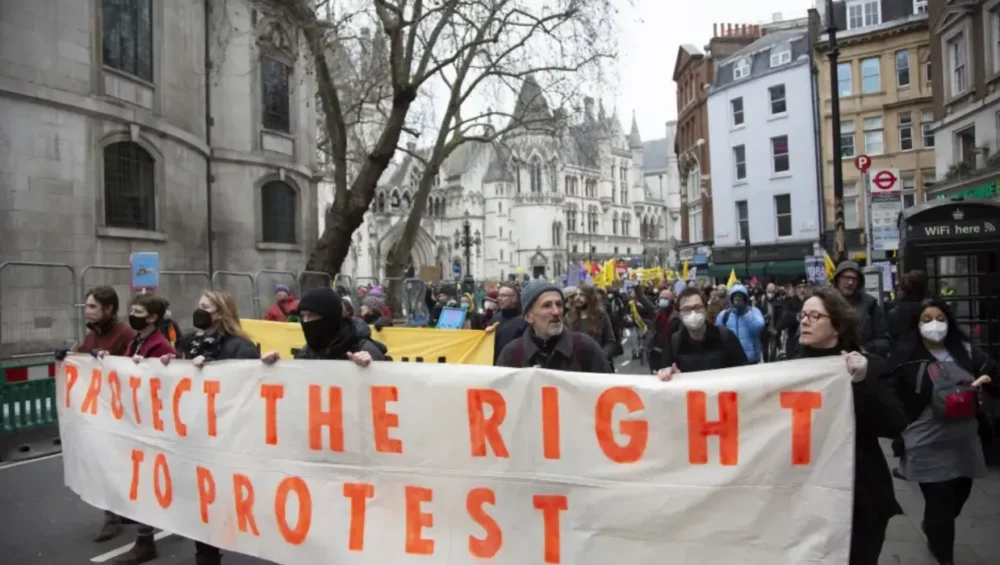
The protest right in England and Wales is under unprecedented attack, say two major reports that point to new and existing laws which are systematically destroying basic rights and criminalizing peaceful protest. According to Human Rights Watch and legal reform organization Justice, new laws have produced a chilling effect on peaceful protest, and new restrictions looming on the horizon could worsen this situation.
Both organisations argue that these measures should be repealed and that proposals for additional curbs must be halted before lasting damage is done to democratic freedoms.
The right to protest is under attack in the United Kingdom.
— Human Rights Watch (@hrw) January 8, 2026
In a new report, HRW documents that the UK’s Labour government has failed to reverse sweeping anti-protest laws introduced by the previous Conservative government.
Learn more: https://t.co/nugDQxj8AH pic.twitter.com/xwGpJOxC2N
Are UK authorities breaching international human rights obligations?
In a report launched Thursday, Human Rights Watch described how the UK government has effectively and profoundly limited the right to peaceful assembly, contrary to international human rights law. The group explained how it believes the current legal framework increasingly views peaceful protest not as a right, but as a criminal threat.
The report points to a string of events including the arrest of anti-monarch Republic protesters during King Charles III’s coronation ceremony, the policing of pro-Palestinian rallies, to the harsh prison sentences meted to supporters of the climate activist group.
Why has Labour failed to reverse restrictive protest laws?
In HRW’s 47-page report titled “Silencing the Streets: The Right to Protest Under Attack in the UK,” the organization argues that the Labour government has not repealed wide-ranging protest suppression laws introduced during the preceding Conservative government. On the contrary, the Labour government has further increased such powers within the Crime and Policing Bill 2025 and the misuse of terrorism laws.
The Crime and Policing Bill is currently pending in parliament and is due for discussion in the House of Lords in January 2026.
How are police powers reshaping protest into a criminal act?
According to Justice and Human Rights Watch, too much police discretion has resulted in a situation in which the current legal framework makes possible pre-emptive arrests and harsh punishments for non-violent conduct. In current legislation, citizens are arrested for possession of commonplace items such as cable ties, bicycle locks, and glue for the assumed intention to use them for “locking-on” during a protest.
During the coronation, Republic supporters were arrested for over 12 hours for possessing plastic ties, although they claimed they were used for holding posters. Later, Metropolitan Police apologized to at least one protester for the arrests.
Have vague laws given police excessive discretion?
As cited from the reports, the convergence of general statutory provisions and the enhanced power of the police has engendered a situation whereby the right to hold demonstrations may be restricted with limited scrutiny. Police and Crimes, Sentencing, and Courts Act 2022 and Public Order Act 2023 immensely increased the police powers to restrict protests, arrest people prior to the protests, and jail them for acts attracting penalties of fines or community service.
This legal ambiguity, the organisations argue, has led to inconsistent and sometimes arbitrary enforcement, increasing uncertainty and discouraging people from exercising their rights.
Why are non-violent protesters receiving prison sentences?
Both reports draw attention to the case of five Just Stop Oil activists sentenced in 2024 to between two and five years in prison for joining a Zoom call to plan a protest—believed to be the longest sentences ever imposed in the UK for non-violent protest activity.
Although the High Court ruled in March 2025 that the sentences were “manifestly excessive” and disproportionate, it reduced them only marginally. Critics say the case illustrates how planning and association are increasingly being treated as criminal offences.
Are peaceful acts being misclassified as serious crimes?
The reports also quote a case wherein Trudi Warner, a retired social worker, was arrested for contempt of court after she silently held a sign outside a courthouse informing jurors about their rights. The High Court dismissed the case as “fanciful” and confirmed that she had not influenced jurors.
Despite this ruling, the Labour government initially pursued an appeal before eventually abandoning the case-a shameful abandonment that spoke to serious concerns about prosecutorial overreach and erosion of free expression.
What new restrictions could further limit protest rights?
Human Rights Watch and Justice have pointed out that some proposed new provisions are only likely to worsen this repression. These proposed provisions cover allowing protesters to be considered cumulatively instead of individually, banning masks during marches, and banning marches outside places of worship.
Further, the Crime and Policing Bill 2025 will also increase the police power which may result in people with insecure immigration status, such as asylum seekers and undocumented migrants, being vulnerable to arrest or deportation..
Is democratic accountability being undermined?
The reports observe that the increasing presence of state power may undermine public participation. Citizens are being arbitrarily arrested, charged, and jailed for peaceful conduct such as attending meetings or participating in planning sessions.
“This is no longer about public safety,”
said Justice chief executive Fiona Rutherford.
“The law has become dangerously unbalanced, empowering the state to silence voices it should be protecting.”
How does the UK compare with declining democracies?
Human Rights Watch explained that it has observed that the UK’s policies on dealing with protests are similar to those of countries whose democratic institutions are deteriorating. “The UK should be resisting these policies, not imitating them,” stated Lydia Gall, a senior researcher of Europe & Central Asia for HRW.
Gall made it very clear that the UK is still obliged to recognize the right to freedom of expression and the right to peaceful assembly under the domestic and international legal framework, including the Human Rights Act.
Can protest rights still be restored?
Both bodies have urged the immediate overhaul of protest legislation and policing in line with international norms that they both contend are being violated. Failure to act, they predict, will only shore up a situation within the UK where the expression of dissent is discouraged, while democratic standards continue to be undermined.
“The UK should be protecting the right to protest, not dismantling it,”
Gall said.
“Lawmakers must remove measures that further restrict peaceful assembly and restore balance to the law.”